
Knowing how to improve CIBIL score in 3 months matters most right after a loan or credit card application gets rejected. A single missed EMI or a maxed-out card is often enough to cause it. The good news is that some fixes may show up within one to three billing cycles. Still, results depend on your report, and nobody can promise a set score. Below you’ll find the steps, a worked example and the mistakes to avoid.
Quick Answer: How to improve CIBIL score in 3 months comes down to five habits. Fix report errors, clear overdue amounts, pay every bill on time, keep card use below about 30% of your limit, and avoid new loan applications. The rise depends on your report, so results may vary.
Table of Contents
What Is a CIBIL Score and Which Factors Change It?
A CIBIL score is a three-digit number from 300 to 900. It shows lenders how reliably you repay credit, and they use it to decide on your loan or card.
TransUnion CIBIL is a credit information company (CIC), meaning a firm regulated by the Reserve Bank of India (RBI) to collect and share credit data. The RBI is India’s central bank and banking regulator. Three other CICs exist: Equifax, Experian and CRIF High Mark. Your score may differ a little between them.
Many lenders see 750 or above as good. But every bank sets its own cut-off, so a high score helps without guaranteeing approval.
Lenders send fresh data to the CICs regularly, and the timing depends on each lender. So what you do this month may only appear after the next reporting cycle. That lag is why learning how to improve CIBIL score in 3 months is realistic for fixable problems.
Which factors affect your CIBIL score most?
Two terms first. Credit utilisation is the share of your card limit that you have used, and our guide to the credit utilisation ratio goes deeper. A hard enquiry is a check a lender makes on your report when you apply for credit.
| Factor | What it means | What you can do in 3 months |
| Payment history | Whether you paid EMIs and card bills on time | Pay every due on time and clear overdue amounts |
| Credit utilisation | The share of your card limit you use | Lower balances before the statement date |
| Credit mix | The balance of secured loans (home, car) and unsecured credit (cards, personal loans) | Do not take a new loan just to change the mix |
| Credit age | How long your accounts have been open | Keep old accounts open |
| New enquiries | Hard checks made when you apply for credit | Avoid new applications |
Payment history and credit utilisation usually respond fastest. Credit age and mix move slowly, so put your energy into the first two.
How to Improve CIBIL Score in 3 Months: A 7-Step Plan
Spend 90 days fixing errors, paying on time, lowering card use and holding off on new credit. Take the steps in order.
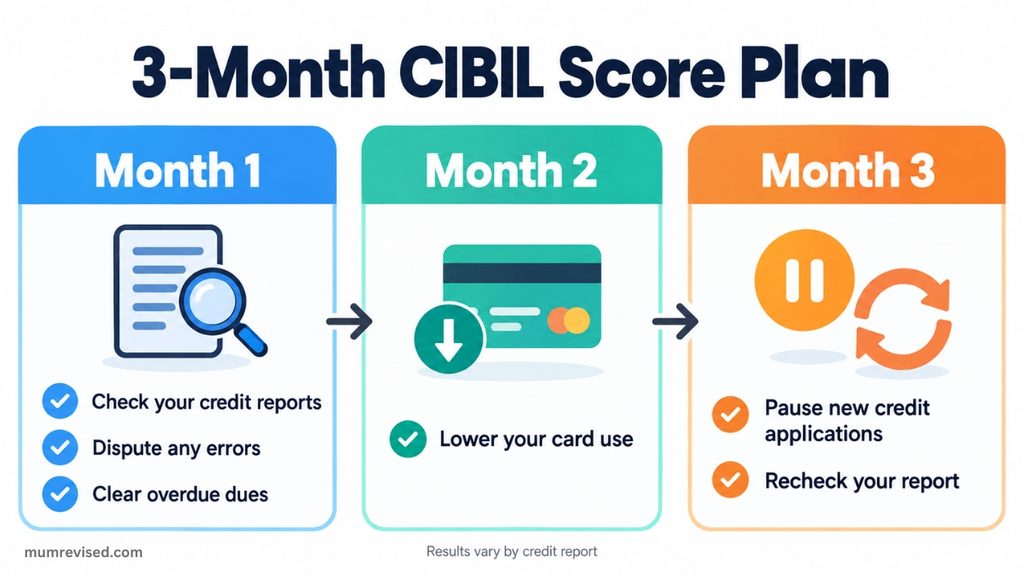
Here is how to improve CIBIL score in 3 months, one month at a time.
Month 1: Check your report and stop new damage
- Get your free credit reports. As per RBI guidelines at the time of writing, each CIC gives you one free full report every year; confirm on the CIC’s official website. Download all four from official sites such as TransUnion CIBIL, because an error may sit in only one. Need help? See how to check your CIBIL score for free.
- Find and dispute errors. Look for accounts you don’t own, wrong dues, and closed loans that still show as open. Then raise a dispute with both the CIC and the lender, since RBI has set timelines for resolving such complaints. The process is in how to dispute errors in a CIBIL report.
- Clear overdue amounts and set auto-pay. Pay any overdue EMI (equated monthly instalment, the fixed amount you repay each month) or card bill first. Then set auto-debit for at least the minimum due, so you never miss a date. Payment history is widely treated as a major scoring factor, so this step matters.
Month 2: Lower your card use
- Bring card use near 30%. A common rule of thumb is to stay below 30% of your limit. Lenders usually report your balance around the statement date, so pay part of your bill before then.
- Keep old cards open. Closing one lowers your total limit, which may push your utilisation up. It may also shorten your average credit age. Keep the card open and put a small regular bill on it instead.
Month 3: Protect your progress
- Pause new credit applications. Each application can create a hard enquiry. A burst of enquiries may look risky to lenders, so wait until your score has recovered.
- Check your report again. After about 90 days, download a fresh report and compare it with the first. Then stick with the same habits, because credit health builds slowly.
How Much Can Lower Card Use Help? A Worked Example
Paying down a card balance can cut your utilisation quickly, and it is one of the faster factors to change. The example below shows the maths in rupees. It covers one part of how to improve CIBIL score in 3 months.
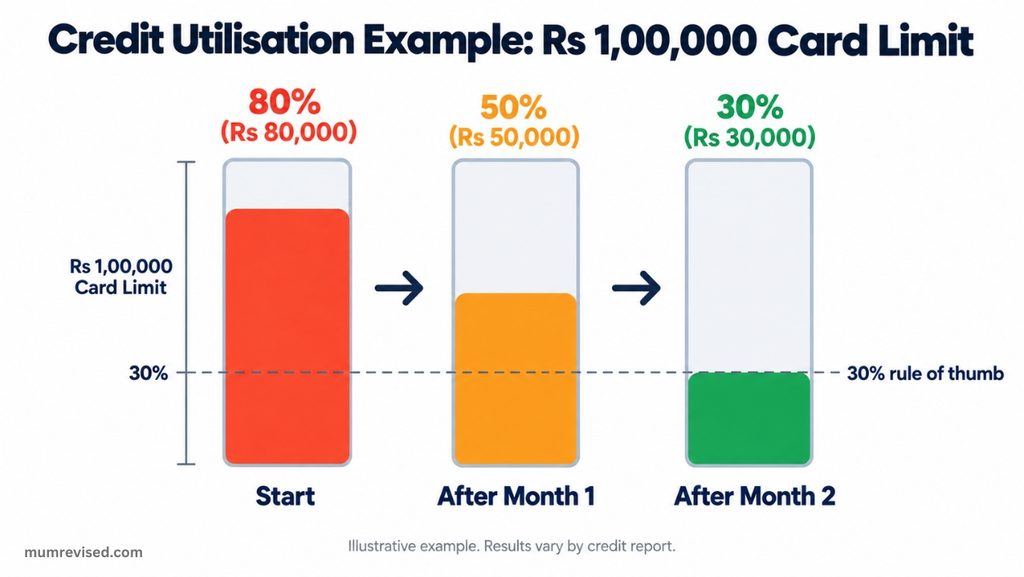
Example (illustrative): A cardholder has a limit of Rs 1,00,000 and a balance of Rs 80,000.
- Current utilisation = 80,000 ÷ 1,00,000 = 0.80, or 80%.
- Target balance at 30% = 30% × 1,00,000 = Rs 30,000.
- Amount to pay down = 80,000 − 30,000 = Rs 50,000.
- Month 1: pay Rs 30,000. The balance becomes Rs 50,000, so utilisation is 50,000 ÷ 1,00,000 = 50%.
- Month 2: pay Rs 20,000. The balance becomes Rs 30,000, so utilisation is 30%.
This assumes no new spending on the card and payments made before the statement date. Utilisation falls from 80% to 30% in two months. The score impact, though, depends on the rest of your report, so don’t read this as a fixed rise in points.
A simple decision rule
Use this order to decide where to start:
- If your report shows errors, dispute them first.
- If it shows overdue amounts, clear them next.
- If utilisation is above 30%, pay down balances after that.
- If all three look fine, avoid new credit and wait for the next cycle.
Pros, Cons and Who Should Try This Plan
This plan suits people whose problem is fixable, such as high card use or small errors. It may not help much if your report shows serious defaults.
Pros
- It costs little, because it mainly needs discipline.
- It builds habits that last beyond 90 days.
- It may improve your chances of loan approval.
Cons
- Results are not guaranteed and differ for each person.
- Old negative entries do not vanish in 90 days.
- You may need spare cash to pay down card balances.
Who should do this
- People with high card balances.
- People who recently cleared late payments.
- People who found errors in their report.
- Borrowers who plan to apply for a loan a few months from now.
Who should avoid this
- People with settled accounts may need a longer plan. A settled account is one where the lender accepted less than the full dues, and it usually affects scores for years.
- People who would have to borrow at high interest to pay card bills should pause and rethink first.
- Anyone tempted by an agent promising a fixed score should walk away.
Which Mistakes Slow Down a CIBIL Score Recovery?
Five habits cause most delays: paying only the minimum, closing old cards, applying everywhere, ignoring errors and trusting quick-fix agents. Each has a simple fix.
Anyone learning how to improve CIBIL score in 3 months tends to trip over the same five habits.
- Paying only the minimum due. The minimum due is the smallest amount a bank asks you to pay each month. It avoids a late mark but leaves a high balance. Fix: Pay the full bill, or enough to bring use near 30%.
- Closing old cards. Fix: Keep them open unless the fees are high.
- Applying to many lenders at once. Fix: Apply only when needed and wait for each decision.
- Ignoring report errors. Fix: Check all four reports and raise disputes quickly.
- Paying “credit repair” agents. No agent can promise a clean report for a fee. Fix: Use free official reports and the steps above. If you suspect fraud, report it on the National Cyber Crime Reporting Portal.
Action Checklist: How to Improve CIBIL Score in 3 Months
Use this six-point list to track your 90 days, and tick each item as you finish it.
- ☐ Download all four credit reports this week.
- ☐ Note every error and raise disputes with the CIC and the lender.
- ☐ Clear all overdue dues and start auto-debit for every EMI and card bill.
- ☐ Pay card balances down to about 30% of the limit before each statement date.
- ☐ Keep old accounts open and pause new applications for 90 days.
- ☐ Download a fresh report after three months and compare it with the first.
Key Takeaways
The core message is simple: fix errors, pay on time, lower card use and give the changes time to show.
- How to improve CIBIL score in 3 months starts with checking all four credit reports for errors.
- On-time payments matter most, so set auto-debit for every EMI and card bill.
- Keeping card use below about 30% of your limit may help your score.
- Don’t close old cards or apply for many loans in a short time.
- Results depend on your report, so no one can promise an exact score.
FAQ: Questions People Ask About Raising a CIBIL Score
These seven answers cover common questions from beginners about quick score improvement.
Can I really raise my CIBIL score in 90 days?
It may be possible, depending on the cause. If the main problem is high card use or a small error, a change may show within a few billing cycles. Serious defaults or settled accounts, however, usually need longer. Nobody can promise an exact score.
How many points can my score rise in one month?
There’s no fixed number, because every report is different. The change depends on your current score, balances, missed payments and errors. Paying down a high card balance or removing a wrong entry may help noticeably. So track your own report rather than believing promises of a guaranteed jump.
What is a good CIBIL score in India?
A CIBIL score runs from 300 to 900. Many lenders treat 750 or above as good, but each bank sets its own rules. A lower score may still get approved, often at a higher interest rate. Check the lender’s official criteria before you apply.
Does checking my own score reduce it?
No. Checking your own report is a soft enquiry, which does not affect your score. A hard enquiry happens when a lender checks your report after you apply for credit. Too many hard enquiries in a short time may lower your score.
Should I close a credit card to improve my score?
Usually not. Closing a card lowers your total credit limit, which may raise your utilisation, and it can reduce your average account age. Keeping it open and using it lightly is usually better. Close a card only if its fees are unavoidable, and clear the balance first.
How long do missed payments stay on my report?
Late payments usually stay on your credit report for several years. The exact period depends on the account status and the CIC’s rules. Newer on-time payments gradually soften the impact. Confirm the current rule on the credit information company’s official website.
What if my score does not improve after three months?
Check your report again for errors or old defaults. If it’s clean, keep paying on time and keep card use low, because gains build slowly. You can also ask the lender or CIC about your case. Skip any agent who promises quick fixes for a fee.
Sources and Further Reading
These official bodies publish the rules and data behind this topic, and the latest versions are always on their own websites.
- Reserve Bank of India (RBI): rules for credit information companies, free annual credit reports and complaint timelines.
- TransUnion CIBIL: score range, credit report details and the dispute process.
- Equifax India, Experian India and CRIF High Mark: the other three credit information companies.
- Credit Information Companies (Regulation) Act, 2005: the law that governs how CICs work.
- National Cyber Crime Reporting Portal: reporting of financial fraud and scams.
This article is for educational purposes only and is not financial advice. Please verify current rates and rules from official sources or consult a SEBI-registered advisor before making decisions.
