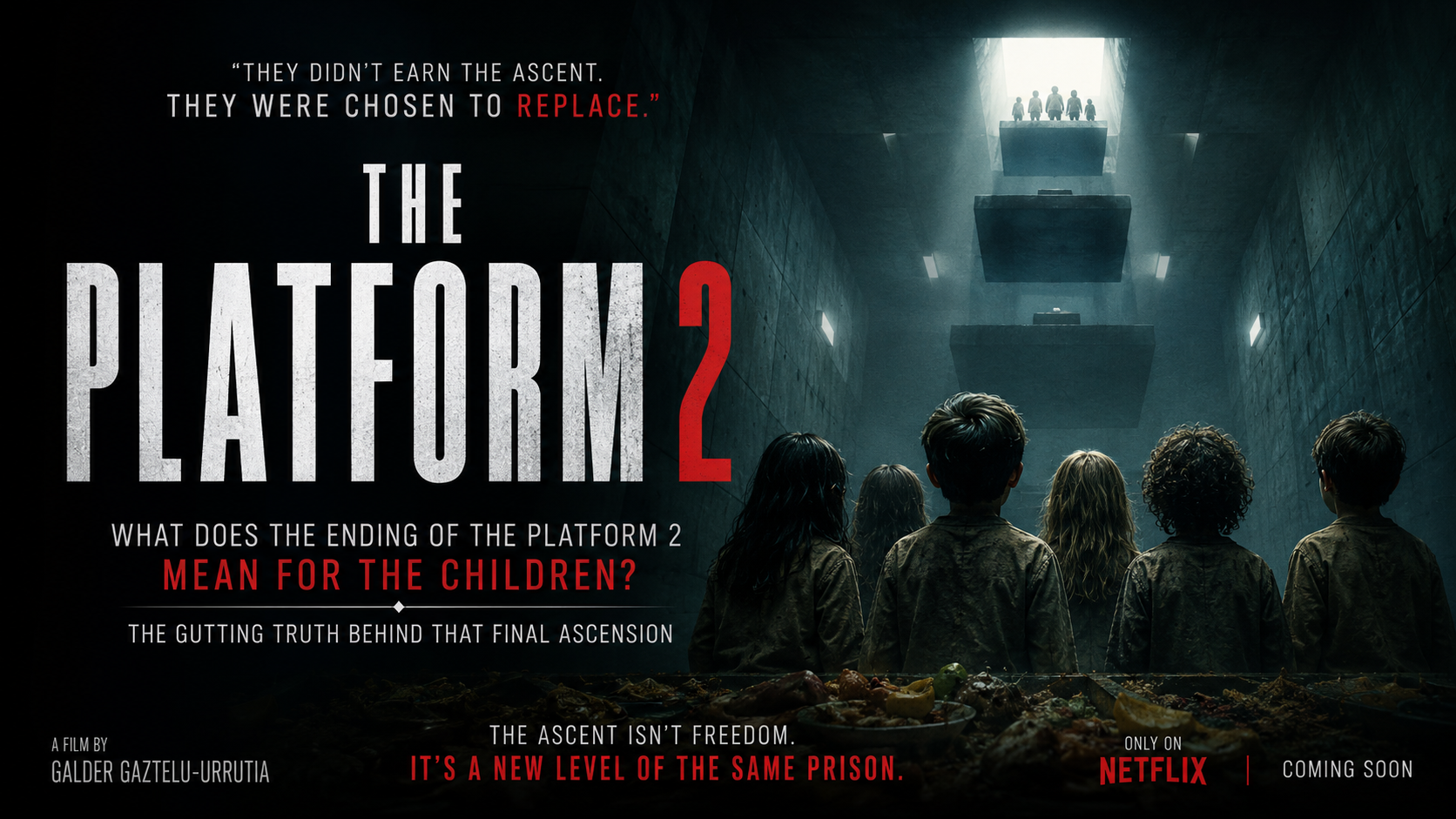
The children in The Platform 2 aren’t just a plot device — they’re the entire moral weight of the film. And if you’ve just finished watching and your brain is doing somersaults, you’re not alone. The question of what does the ending of The Platform 2 mean for the children is genuinely one of the most layered things this sequel does, and it’s worth unpacking carefully.
At a Glance
| Detail | Info |
|---|---|
| Title | The Platform 2 (El hoyo 2) |
| Genre | Sci-Fi / Horror / Thriller |
| Release Date | October 4, 2024 |
| OTT Platform | Netflix |
| Cast | Milena Smit, Hovik Keuchkerian, Natalia Tena, Óscar Jaenada, Iván Massagué, Zorion Eguileor |
| Director | Galder Gaztelu-Urrutia |
What’s Actually Happening With the Kids?
Before we get into the ending, a quick refresher: The Platform 2 is set in the same brutal vertical prison — The Pit — from the first film. Each floor houses two inmates, and a food-laden platform descends daily. Those at the top eat their fill; those at the bottom starve. New to this sequel is a disturbing addition: children are now part of the system.
The film follows Perempuán (Milena Smit), a new prisoner who gets swept into a rebellion against a food distribution system enforced by an unseen, almost mythical leader. Throughout the runtime, there are recurring flashes of children playing around a pyramid structure — orderly at first, then descending into chaos as they scramble to reach the top. It’s visually striking and thematically loaded.
Here’s the thing the film is quietly saying: the children represent humanity in its earliest, most malleable state. The pyramid sequence isn’t just a disturbing image — it’s a microcosm of the entire Pit’s logic. Even children, placed in a competitive, scarcity-driven system, will eventually abandon cooperation for survival.
The Ending, Broken Down
⚠️ MAJOR SPOILERS AHEAD
By the film’s final act, Perempuán has hatched an escape plan borrowed from her deceased cellmate. She fakes her own death to survive the monthly “intervention” — the period when the administration clears out bodies, reshuffles inmates, and cleans the platform. She wakes up during the shuffle and, rather than escaping for herself, she focuses on something else entirely: saving a child placed at level 333.
Level 333, in the universe of The Platform, is essentially a death sentence. It’s the lowest recognised level — the symbolic end of the line.
Perempuán rescues the boy and takes him down on the platform to the very bottom of the Pit — below level 333, into territory the film implies is more purgatory than prison. Here she’s met by spirits of the dead, who tell her something crucial: the child must go back up. Children, it turns out, ascend when the platform rises. Perempuán’s sacrifice was, in a sense, unnecessary for the boy’s immediate survival — but it was absolutely necessary for her own soul’s redemption.
She sacrificed herself not because it was the logical move, but because it was the human one.
What Do the Children Symbolise?
The children in The Platform 2 function on three levels simultaneously:
1. Innocence entering a corrupt system. The administration knowingly introduces children into The Pit as part of its behavioural experiment. They’re not accidents — they’re variables. The film frames this as the ultimate indictment of systemic cruelty: a structure so broken that it deliberately places the vulnerable inside it just to observe what happens.
2. The future being inherited. The pyramid scene isn’t random. One child claws their way to the top — only to later appear at level 333, the place of death. The winner of a rigged game still loses. Whatever system these children grow into, it will crush them. That’s the film’s bleakest observation.
3. Hope, despite everything. And yet — Perempuán acts. She sees a child in danger and chooses sacrifice over self-preservation. The film doesn’t promise the child’s life will be better, but the act of choosing him matters. That’s the film’s only genuine flicker of warmth.
The Mid-Credits Twist: Where Does This Connect to Film One?
Here’s where things get genuinely clever. The mid-credits sequence shows other adult prisoners doing what Perempuán did — taking children down on the platform. Some protect the child. Others abandon them at the bottom to save themselves. One of the adults shown doing this is Goreng — the protagonist of the original The Platform.
And then the kicker: Perempuán walks out of the darkness and encounters Goreng. They hug. She asks, “What are you doing here?” He says nothing, but the implication is massive.
The Platform 2 is a prequel — or at least runs parallel to events before the first film. Trimagasi (who died in The Platform) appears alive here, confirming the timeline. Perempuán was apparently Goreng’s girlfriend, referenced but never seen in the original. The ending of The Platform 2 loops directly into the opening conditions of The Platform 1.
The cycle doesn’t break. It restarts.
Key Events Timeline
| Event | What It Means |
|---|---|
| Perempuán arrives at The Pit | Protagonist introduced; new food law in effect |
| Children appear in pyramid sequences | Symbol of societal conditioning from birth |
| Perempuán fakes her death | Pivotal act of agency in a system designed to break you |
| She rescues the child at level 333 | Redemption arc — choosing the vulnerable over self |
| Spirits tell her the child ascends | The child was always going to survive; she gave herself away anyway |
| Mid-credits: Goreng appears | Confirms Platform 2 is a prequel/parallel story to Platform 1 |
| Perempuán and Goreng reunite | Emotional closure — and the cycle begins again |
Will There Be a Platform 3?
Honestly? The mid-credits scene feels deliberately engineered to leave that door open. The franchise has now established itself as a kind of anthology universe — same Pit, different inmates, different moral dilemmas. Whether Netflix orders a third film likely depends on how Platform 2 performs globally, but the story structure absolutely supports continuation.
Binge Score
| Category | Score |
|---|---|
| Story | 7/10 |
| Pacing | 6/10 |
| Acting | 8/10 |
| Rewatch Value | 6/10 |
Verdict: The Platform 2 doesn’t quite recapture the suffocating dread of the original, but Milena Smit anchors it with a performance that earns every bit of its emotional payoff. The children subplot is where the film finds its real teeth — and its heart.
You May Also Like
- The Platform (2020) — Netflix — Obviously. The prequel-that’s-a-sequel connection makes this a mandatory rewatch with fresh eyes.
- Snowpiercer (2013) — Available on OTT platforms — Class warfare on a train; same vertical hierarchy, same brutal satire of how societies consume their own.
- Squid Game (2021) — Netflix — If you’re into games that weaponise childhood innocence and expose systemic rot, this remains the gold standard.