Your rent takes 45% of your paycheck, but a popular budgeting rule says housing should stay near 30%. Frustrating, right? That’s exactly what the 50/30/20 rule breakdown for high cost of living areas fixes.
The idea is simple: keep the same three buckets, but resize them so Needs get 60% to 65% of your take-home pay. This guide gives you the adjusted splits and worked examples with real numbers, plus a step-by-step method to build your own version. You’ll also see the mistakes that quietly wreck budgets in expensive cities.
Quick Answer: In a high cost of living area, shift the 50/30/20 rule to 60/20/20 or 65/20/15. Needs like rent, food, transport and insurance take 60% to 65% of take-home pay. Wants stay near 20%, and savings or debt payoff get 15% to 20%. Keep savings above 10% even in tight months.
Table of Contents
What Is the 50/30/20 Rule Breakdown for High Cost of Living Areas?
It’s the classic 50/30/20 budget with a bigger Needs bucket. Instead of 50% for Needs, 30% for Wants and 20% for savings, you move to something like 65/20/15 or 60/20/20. The exact numbers depend on what your local rent and bills actually cost.
The original rule was popularized by Senator Elizabeth Warren and her daughter Amelia Warren Tyagi in their book All Your Worth. Everything is based on after-tax income, meaning the money that actually lands in your bank account.
Here’s how the three buckets work. Needs are costs you can’t skip: rent, utilities, groceries, basic transport, insurance and minimum debt payments. Wants are the extras, like dining out, streaming and trips. Savings cover your emergency fund, retirement and any extra debt payments.
Take a hypothetical take-home pay of $4,000 a month. The classic rule gives you $2,000 for Needs, $1,200 for Wants and $800 for savings. A high-cost version at 65/20/15 gives you $2,600, $800 and $600. That’s the 50/30/20 rule breakdown for high cost of living areas in one line: same method, honest numbers.
Why Does the Standard 50/30/20 Budget Break in Expensive Cities?
Because the rule was built around average costs, and average isn’t what you pay in a city where rent runs far above typical levels. Housing alone can swallow most of your Needs budget before groceries even show up. Parking, childcare and longer commutes pile on top.
Let’s run a hypothetical. Say a renter takes home $4,500 a month. Rent is $1,800, utilities $180, groceries $450, transport $250, health insurance $200 and phone $60. That adds up to $2,940, or about 65% of take-home pay.
The classic rule allows only $2,250 for Needs. So this person is $690 over before spending a dollar on fun. Something has to give.
Usually, one of two things happens. Either the person ignores the rule and feels like a failure, or they squeeze Needs so hard that the budget collapses by week three. Neither helps. A rule you break every month isn’t a rule, it’s guilt with a spreadsheet.
The better move is to change the rule to fit the math. Once you accept that Needs run at 65%, the leftover $1,560 can still be split sensibly, for example $900 for Wants and $660 for savings.
Which Split Works Best: 60/20/20, 65/20/15 or 70/15/15?
Pick the split that sits just above your real Needs percentage. If Needs land between 60% and 65%, use 65/20/15. If you can squeeze them under 60%, go with 60/20/20. Use 70/15/15 only when Needs truly sit near 70%.
Here’s my take: savings should be the last bucket you cut, and Wants should be the first one you trim. Wants are flexible. Skipping savings, on the other hand, quietly costs you later when a car repair or a layoff shows up.
That said, don’t cut Wants to zero. A budget with no fun in it usually lasts about a month. Keep at least 10% for Wants so you actually stick with the plan.
| Split | Needs / Wants / Savings (on $4,500 take-home) | Best fit |
|---|---|---|
| Classic 50/30/20 | $2,250 / $1,350 / $900 | Average-cost areas or shared housing |
| 60/20/20 | $2,700 / $900 / $900 | Moderately expensive cities |
| 65/20/15 | $2,925 / $900 / $675 | Expensive metros, solo renters |
| 70/15/15 | $3,150 / $675 / $675 | Very high rent |
| 75/10/15 | $3,375 / $450 / $675 | Temporary phase, like a new city or new job |
Notice that savings never drop below 15% in this table. That’s on purpose. If you carry high-interest credit card debt, count your extra payments as part of the savings bucket and push them hard.
How Do You Adjust the 50/30/20 Budget Step by Step?
The process takes about an hour the first time. After that, it’s a quick check every few months. Follow the steps below in order, because each one feeds the next.
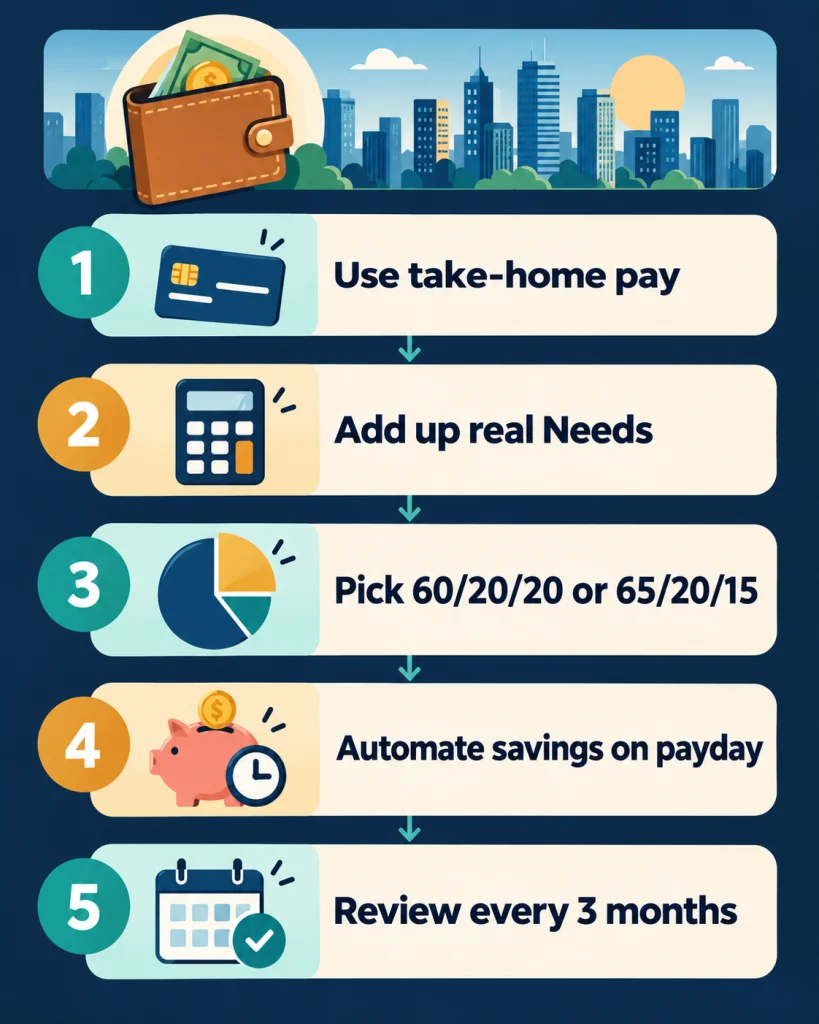
Your 50/30/20 Rule Breakdown for High Cost of Living Areas in Five Steps
- Find your take-home pay. Use the amount that lands in your account after tax and payroll deductions. If you add to a workplace retirement plan, count that money toward savings.
- Add up your real Needs. Pull three months of bank statements, total rent, bills, groceries, transport and insurance, then divide by take-home pay. how to track monthly expenses can make this faster.
- Pick the split just above your Needs percentage. At 63% Needs, choose 65/20/15. At 58%, 60/20/20 works fine.
- Fix your Wants amount and automate savings. Set an automatic transfer for payday so the money leaves before you can spend it.
- Review every three months. Rent renewals, raises and new bills all change the math.
How Can You Sanity-Check Your Local Costs?
Not sure whether your Needs are normal for your area? The MIT Living Wage Calculator lets you look up estimated basic living costs for a county or metro area and several family types. It’s built around US locations, so if you live elsewhere, use local rent listings and your own utility bills instead.
What Does the 50/30/20 Rule Look Like With Real Numbers?
Numbers make this click, so let’s walk through two hypothetical households. Neither is a real person, but the math is realistic.
First, a couple with a toddler. Their combined take-home pay is $9,000 a month. Rent is $3,000, childcare $1,800, groceries $900, transport $500, insurance $450 and utilities $250.
That’s $6,900 in Needs, or about 77%. It’s higher than even the 75/10/15 row in the table, which tells you something honest: this is partly an income and housing problem, not just a budgeting one. A realistic plan for now is $700 for Wants and $1,400 for savings, while they look for ways to lower childcare or housing costs.
Now the roommate swap. Take the single renter from earlier, with $4,500 take-home pay. If they share a two-bedroom, rent drops to $1,100 and utilities to $90. Needs fall to $2,150, about 48%.
Suddenly the classic 50/30/20 split fits again. With Wants held at $1,350, savings can climb to roughly $1,000 a month. Compare that with the $660 from the solo apartment plan. That’s an extra $340 a month, or $4,080 a year, from one housing decision.
How Can You Lower Your Needs Without Moving Out?
Go after housing first, insurance second and transport third. Cutting lattes won’t touch a Needs problem sitting at 65%. The big line items are where the real room is.
- Rent: ask about renewal terms before you sign. A landlord with a reliable tenant often prefers a small increase over an empty unit.
- Spare room: if your lease allows it, a roommate or sublet can cut your share of rent sharply.
- Insurance: compare quotes once a year. Saving $40 a month adds up to $480 a year.
- Transport: price out a monthly transit pass against parking, fuel and car insurance.
- Groceries: plan meals for the week and buy store brands on staples.
Small wins stack up. A $40 insurance saving plus $60 at the grocery store is $100 a month, or $1,200 a year. On a $4,500 income, that moves your Needs share down by more than two percentage points.
Common Mistakes With the 50/30/20 Rule Breakdown for High Cost of Living Areas (and Pro Tips)
Most budgets fail for boring reasons. These are the ones that show up again and again.
- Using gross pay instead of take-home pay. Your budget only works with money you actually receive.
- Calling Wants “Needs.” Try this test: if you stopped paying for it, would you be in real trouble within 30 days? If not, it’s a Want.
- Ignoring irregular costs. Annual insurance, car repairs and holiday gifts wreck months that looked fine. Divide the yearly cost by 12 and set that amount aside monthly.
- Cutting savings to zero. It feels like a quick fix, but it leaves you one surprise bill away from credit card debt.
- Setting the budget once and forgetting it. Rent changes, raises and new bills mean your split needs a refresh.
Now for a few pro tips. Keep savings in a separate account so you’re not tempted to dip into it. Build a small cushion first, then grow it, and how to build an emergency fund covers that step by step. For free worksheets from a government source, see Consumer Financial Protection Bureau budgeting resources.
FAQ: 50/30/20 Rule Breakdown for High Cost of Living Areas
Does the 50/30/20 rule work in expensive cities?
Yes, but only after you adjust it. The original percentages assume average costs, so they often fail where rent is high. Moving to 60/20/20 or 65/20/15 keeps the three-bucket structure while matching your real bills. The system works. The default numbers are what need changing.
How much of my income should go to rent in a high cost of living area?
A common guideline is 30% of gross income, but many renters in expensive cities pay more. A workable target is keeping housing near 40% of take-home pay, with total Needs at or below 65%. If rent goes higher, trim other Needs or raise income, and never fund it by cutting savings to zero.
What’s the minimum savings rate I should keep?
Aim for 15% or more when you can, and treat 10% as a floor for tight months. Even a small automatic transfer builds the habit and gives you a cushion for surprises. If you carry high-interest debt, count extra payments toward this bucket until the debt is gone.
Do debt payments count as Needs or savings?
Minimum payments are Needs, because missing them hurts your credit and costs fees. Anything extra you pay beyond the minimum belongs in the savings and debt bucket. Splitting it this way shows how much of your income is locked in versus how much you’re actively using to get ahead.
How often should I update my budget?
Check it every three months, and again whenever something big changes, like a rent increase, new job, move or baby. A quick review takes about 20 minutes. Compare your real Needs percentage to your chosen split, then adjust Wants or savings to match.
What if my Needs are above 70% of my income?
Treat it as an income or housing problem, not a willpower problem. Keep a small automatic savings amount, hold Wants to the bare minimum, and work on a raise, a roommate or cheaper housing. A nonprofit credit counselor can often review your numbers for free or at low cost.
Final Verdict
My verdict: don’t force the original 50/30/20 split onto a city that doesn’t fit it. Use 65/20/15 as your starting point, protect your savings, and treat Wants as the flexible bucket. If your Needs sit above 65%, the real work is lowering housing costs or raising income, not shaving coffee.
Your next step takes ten minutes tonight. Open your last three bank statements, add up your Needs, and divide by your take-home pay. Then pick the row in the table that sits just above that number and set an automatic savings transfer for payday.
Disclaimer: This article is for general education and isn’t personalized financial advice. Your income, taxes and local costs are different, and all examples above are hypothetical. Talk to a licensed financial planner or a certified credit counselor before making big money decisions.