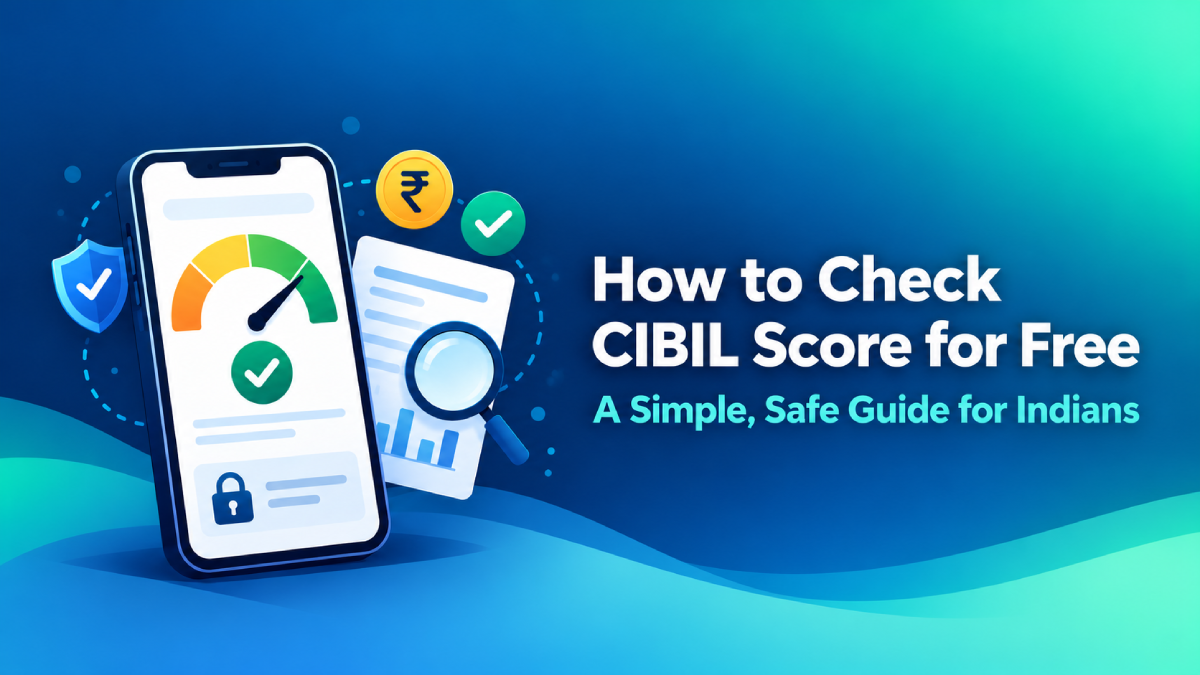
If you want to know how to check CIBIL score for free, you’re in good company. Plenty of people only look at their score after a loan or card application gets rejected. That’s a stressful moment to discover an error. The good news is that checking costs nothing, takes about ten minutes, and doesn’t hurt your score. Here are the safe steps, the official sources and the mistakes to dodge.
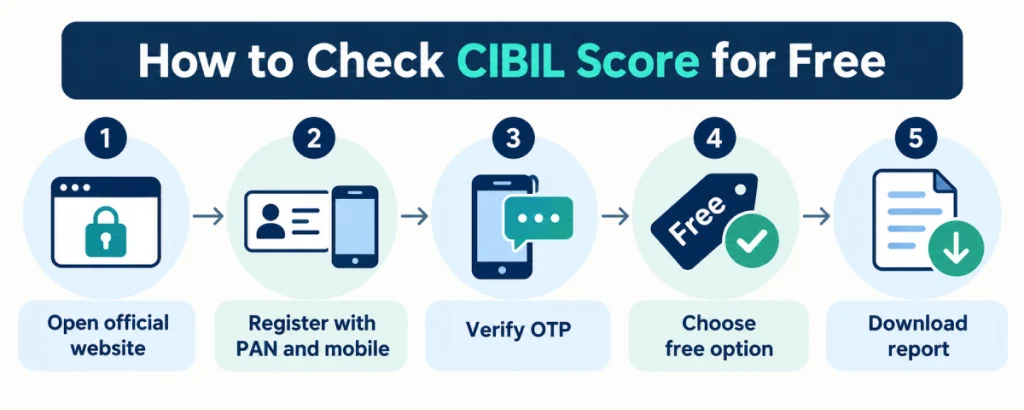
Quick Answer: Here is how to check CIBIL score for free: visit the official TransUnion CIBIL website, register with your name, PAN and mobile number, verify the OTP, and open your free report. Banks and lender apps also show free scores. A free check is a soft enquiry, so it does not lower your score.
Table of Contents
What Is a CIBIL Score and Why Does It Matter?
A CIBIL score is a three-digit number, usually between 300 and 900, that shows how reliably you repay credit. Lenders use it to judge risk before they approve a loan or card.
TransUnion CIBIL is a credit information company, meaning it collects repayment records from banks and lenders. A credit information company is a bureau licensed by the Reserve Bank of India (RBI), India’s central bank. You can read more about the regulator on the Reserve Bank of India website.
Your lenders will be banks or NBFCs. An NBFC is a non-banking financial company that gives loans without a full banking licence.
Now, a score and a report aren’t the same thing. The report is the full history of your loans, cards and payments. The score is a short summary of that history. A missed EMI, for example, shows up in the report first, and it may then pull the score down.
A score of 750 or above is often seen as good, though each lender sets its own rules. For the ranges in detail, read what is a good CIBIL score. Also, India has more than one credit bureau, so your score may differ slightly from one to another.
Before you learn how to check CIBIL score for free, it helps to know what the number means. It reflects your habits, not your worth.
How to Check CIBIL Score for Free: 5 Steps
You can check your score for free by registering on the official CIBIL website and verifying your identity. It usually takes about ten minutes. You’ll need your PAN, mobile number and email address.
PAN, or Permanent Account Number, is a ten-character tax ID issued by the Income Tax Department. Keep it handy before you start.
- Open the official website. Type the address of the official TransUnion CIBIL website yourself rather than clicking an advertisement. Lookalike sites exist, so typing it in is a cheap way to protect your data.
- Register with your details. Enter your name, date of birth, PAN, mobile number and email. Use the same details your lender has, because mismatches can cause missing records.
- Verify with an OTP. An OTP, or one-time password, is a short code sent to your phone to prove it’s you. The site may also ask a few questions about your past loans.
- Pick the free option. Look for the free score or the free annual report. As per RBI guidelines at the time of writing, you can get one free full credit report each year from each credit information company; confirm on the official website. Skip paid plans unless you want ongoing monitoring.
- Download and store the report. Save the file in a private folder. Don’t email it or upload it to unknown sites.
These steps also work in a phone browser. The layout may change over time, though, so follow the on-screen prompts.

Which Free Methods Can You Use to Check Your Score?
You can use the official bureau website, your bank or lender portal, or another bureau’s free report. Each route works for how to check CIBIL score for free, but they give different levels of detail.
| Method | What you usually get | Cost | What to watch |
| Official CIBIL website | Score and full report | Free report as per RBI rules; paid plans are optional | Avoid upsells you do not need |
| Bank or lender app | Score, sometimes only a summary | Often free for customers | May show data from one bureau only |
| Other bureaus’ websites | Their own score and report | One free report a year as per RBI rules | Score may differ from CIBIL |
| Third-party apps | Score and general tips | Often free | Check the privacy policy and who runs the app |
Here’s a simple way to choose. If you plan to apply for a loan soon, get the full free report first. If you just want a quick monthly look, a bank or lender app is usually enough. And if the score looks wrong, compare it with a second bureau’s report.
Every route above is a soft enquiry, which is a check you make on your own record. It doesn’t affect your score. A hard enquiry is different: it happens when a lender checks your report after you apply for credit. Several hard enquiries in a short time may lower your score.
How Do You Read Your Score and Report?
Start with the score, then review four report areas: personal details, accounts, payment history and enquiries. An error in any of them may pull your score down.
What to Check First
Go through the report slowly, one section at a time.
- Personal details: Check your name, PAN, address and date of birth.
- Accounts: Every loan and card should be yours and marked open or closed correctly.
- Payment history: Look for late payments you didn’t make or have already cleared.
- Enquiries: Look for lender checks you don’t recognise.
Next comes credit utilisation, which is the share of your total card limit that you’re using. Lenders usually prefer it lower, so it’s worth a closer look.
Example (illustrative)
Suppose a reader has two credit cards with a combined limit of Rs 2,00,000. Her total outstanding balance is Rs 90,000.
- Divide the balance by the limit: Rs 90,000 ÷ Rs 2,00,000 = 0.45.
- Multiply by 100: 0.45 × 100 = 45% utilisation.
- She pays Rs 50,000, so the new balance is Rs 90,000 − Rs 50,000 = Rs 40,000.
- New utilisation: Rs 40,000 ÷ Rs 2,00,000 = 0.20, or 20%.
Many credit guides suggest staying under about 30%, so the lower figure is usually healthier. Still, no single level guarantees a particular score. Bureaus update only after lenders report, so a change may take a billing cycle to show. That’s why knowing how to check CIBIL score for free pays off: you can watch changes like this over time.
Pros, Cons and Who Should Check Their Score
Learning how to check CIBIL score for free is usually low-risk and useful, because it shows errors early. The main downsides are the time it takes and the risk of fake websites.
Pros
- It helps you spot errors before a lender does.
- It costs nothing when you use the free options.
- It’s a soft enquiry, so it doesn’t hurt your score.
- It helps you plan loan or card applications.
Cons
- Different bureaus show different numbers, which can confuse beginners.
- Fake sites and paid upsells can mislead you.
- A score alone doesn’t decide approval, because lender policy also matters.
Who Should Do This
Check if you’re planning a loan or card in the next six months. Check if you’ve never seen your credit report. And check if you’ve had a rejection or spot enquiries you don’t recognise.
Who Should Avoid This
Skip it on a public computer or shared Wi-Fi, because your data may be exposed. Stop, too, if someone pressures you to share an OTP or to pay a stranger who promises a higher score. Wait until you have a safe device and a trusted route instead.
Common Mistakes in How to Check CIBIL Score for Free
Most slip-ups in how to check CIBIL score for free come from rushing, and each has a simple fix.
- Trusting the first search result. Fix: type the official address yourself or use your lender’s verified app.
- Paying for a “free” report. Fix: look for the free option and skip add-ons you don’t need.
- Sharing OTPs or PAN details with callers. Fix: keep OTPs private, and report fraud on the National Cyber Crime Reporting Portal.
- Using details that don’t match your loan records. Fix: enter your name, date of birth and PAN exactly as your lender has them.
- Ignoring errors once you find them. Fix: raise a dispute with the bureau and your lender, as explained in how to fix errors in your CIBIL report.
Action Checklist: What to Do After You Check
Use your result to take small steps over the coming months. This checklist keeps you on track.
- Save your report with today’s date.
- Match every loan and card with your own records.
- Report any error to the bureau and the lender.
- Pay every EMI and card due on time, because payment history usually matters a lot.
- Keep card utilisation low, as shown in the example above.
- Repeat how to check CIBIL score for free every few months, and read how to improve your CIBIL score for next steps.
Frequently Asked Questions
Does checking my own CIBIL score lower it?
No. Checking your own score is a soft enquiry, so it doesn’t reduce it. A hard enquiry happens when a lender checks your report after you apply for credit. Many hard enquiries within a short period may lower your score. So you can check your own report without worry.
How often can I check my score for free?
As per RBI guidelines at the time of writing, each credit information company must give you one free full credit report every year. Some banks and apps also show free scores more often. Confirm the current limit on the official website, because rules can change.
Is a free score different from a paid one?
Not usually. The score often comes from the same data, so free and paid views may match. Paid plans typically add extras such as alerts or monitoring. A score from another bureau can differ, however, because each bureau holds its own records and uses its own method.
Can I check my score without a PAN?
Most platforms ask for a PAN because it helps match your records correctly. Some may accept other IDs, such as a passport or voter ID, but this depends on the platform. So keep your PAN ready, and confirm accepted IDs on the website you use.
Why does my score differ on two apps?
Different apps may use different credit bureaus, and each bureau holds its own records. Lenders also report on different dates, so one report may be newer. Scoring models differ too. Compare the bureau name and update date before you worry about a gap.
What should I do if my report has a mistake?
Raise a dispute on the bureau’s website and also tell the lender that reported the data. Keep proof such as payment receipts and loan closure letters. As per RBI guidelines at the time of writing, disputes must be resolved within set timelines; confirm the current timeline on the official website.
Is it safe to check my score on a mobile app?
It can be safe if the app belongs to a regulated lender or an RBI-licensed bureau. Download it only from your phone’s official app store. Read the privacy policy first. Avoid unknown apps that ask for extra permissions, and never share your OTP.
Key Takeaways and Sources
Key Takeaways
- The simplest way to learn how to check CIBIL score for free is to use the official CIBIL website or your lender’s verified app.
- A self-check is a soft enquiry, so it doesn’t lower your score.
- Use the same details as your loan records, and keep your OTP private.
- Read the full report for errors, not just the score.
- Lower card utilisation and on-time payments usually help over time, but no result is guaranteed.
Sources and Further Reading
- Reserve Bank of India (RBI), for credit information company rules and consumer guidance
- TransUnion CIBIL, for score and report services
- Equifax, Experian and CRIF High Mark, the other RBI-licensed credit bureaus
- Income Tax Department of India, for PAN information
- National Cyber Crime Reporting Portal, for reporting online fraud
This article is for educational purposes only and is not financial advice. Please verify current rates and rules from official sources or consult a SEBI-registered advisor before making decisions.